Risks and Threats on Darknet Markets
Darknet markets sit at the intersection of anonymous operators, pseudonymous users, and
law-enforcement interest. Threats stack from three directions — the platform, your
counterparty, and your own choices.
Platform and Custodial Risk
Markets hold funds in custodial wallets or coordinate escrow on infrastructure they control.
Exit scams — administrators draining deposits and vanishing — remain the archetypal platform
failure. Withdrawal delays, silent admins, and sudden downtime often precede them. Walletless
payment models and multisig escrow reduce how much sits in a single pool, but they do not
remove trust in the software, moderators, or keys the platform holds.
Vendor and Counterparty Fraud
Vendors can ship nothing, ship substitutes, or exit with outstanding orders. Buyers can claim
non-receipt while keeping goods. Reputation systems and escrow moderators mitigate some fraud,
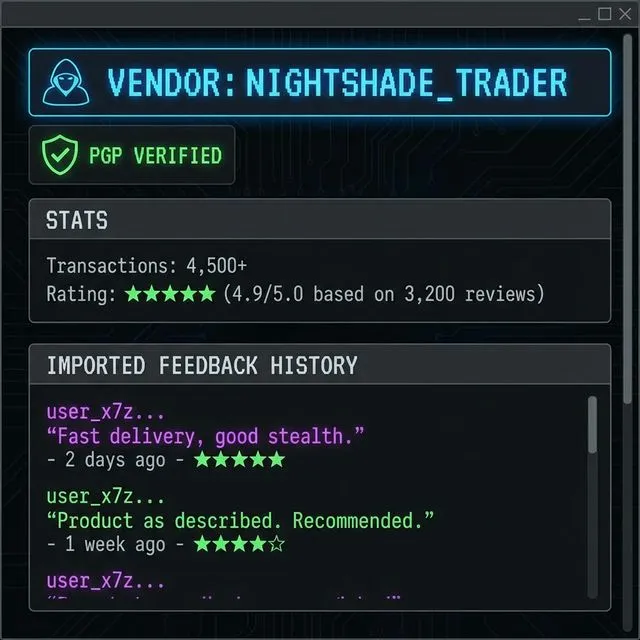
but reviews can be faked, shills purchased, and imported feedback manipulated. A long history on
one market does not transfer trust automatically to the next after a migration.
Phishing, Fake Mirrors, and Session Compromise
Attackers clone login pages, distribute lookalike .onion addresses, and harvest
credentials through forum links or typosquatting. Session cookies and stolen passwords bypass
escrow entirely. PGP-signed mirror announcements help only when you verify the signing key's
fingerprint independently — see the
PGP signature verification guide. A valid signature
on a malicious URL still points to the key holder's chosen destination.
Database Breaches and Metadata Exposure
Seized or leaked databases expose usernames, hashed passwords, PGP keys, internal messages, and
support tickets. Encryption claims on a market's marketing page are not proof that plaintext
never existed on disk. Historical breaches have linked pseudonyms across services and fed
downstream investigations.
DDoS, Downtime, and Migration Scams
Markets face denial-of-service pressure from competitors, extortionists, or activists. Extended
outages push users toward unverified "official" replacement URLs posted on forums. Migration
scams exploit panic: a convincing announcement and a fresh phishing onion can harvest deposits
before users realize the real market has not returned.
Cryptocurrency Tracing and Off-Chain Records
Bitcoin's public ledger lets analysts follow flows from market wallets toward exchanges, mixers,
and known services. Monero hides more on-chain detail, but exchange KYC, shipping addresses,
device seizures, and timing still connect people to transactions. See the
Monero privacy guide for protocol limits — not a guarantee
of untraceable payments end to end.
Law-Enforcement Operations
Agencies infiltrate staff, run undercover vendor accounts, exploit application bugs, and
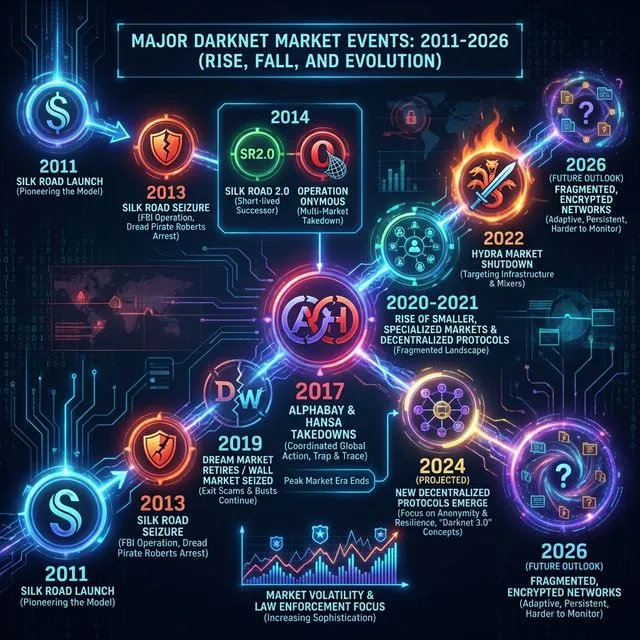
coordinate multinational takedowns. Operations like Bayonet (2017) and SpecTor (2023) show that
scale and cooperation matter as much as any single technical trick. Onion routing complicates
network tracing; it does not immunize operators who slip on OPSEC.
Limits of Escrow, Multisig, PGP, and Reputation
Escrow requires trusting moderators to rule disputes honestly. Multisig adds keys but still
depends on humans choosing co-signers and reading fine print. PGP proves a message matched a key
— not that the key owner is honest. Star ratings aggregate past behavior that may be gamed or
stale. None of these tools convert an anonymous marketplace into a regulated consumer
protection regime.
Three risk layers
Platform risks — exit scams, seizures, moderator bias.
Counterparty risks — vendor fraud, buyer chargebacks, fake reviews.
User-side risks — phishing clicks, reused passwords, sloppy payments.
Technical guides for your side of the line:
verify signatures,
Monero privacy, and
OPSEC habits — without repeating their full
instructions here.